Where do your feet take you?
When I travel abroad, I do a lot of walking. For me, traveling abroad means England. That will expand eventually, but for the last ten years, that's been where the big ol' jet airliner takes me.
England is a very old country and very walkable. In fact, my favorite place there closes its city centre to all but pedestrian traffic for the greater part of the day. As you walk through the ancient streets of York, you can safely look around at the architecture of the centuries, the lovely shop windows, the tempting wares in the cafes and bakeries, the colorful sights of the market, and so much more. Well, safe from most vehicle traffic, but watch for the cyclists who are usually in a hurry.

That said, don't forget to look down. You coujld spot something whimsical like this little mouse house on the Shambles. You might also see medallions in the pavement that mark where Roman walls or roads originally stood.
When walking an old city like York, looking down serves another purpose: safety. The surface underfoot is often uneven, with unexpected slopes, dips, ridges, and humps that might be a possibly unnoticed variance to people with healthy vision, b ut potentially dangerous to someone with low vision. A lack of depth perception only compounds the problem.
After many stumbles (thankfully, only one fall), I've learned to watch where I'm treading, but even then, surprises happen with certain surfaces. Some minefields are obvious, like these broken stones.

Others are more subtle. Bricks that have been in place for ages are uneven, for sure, but do you see the slope ahead here? The trick is that there's more than one.


And what is an ancient street without cobbles? Obviously, those will be a challenge, but you can't miss the experience of being among buildings that have stood for hundreds of years and are still in use. Pictured is one such street (the Shambles) that's irresistable, but look at where the visitors are walking. A walkway on either side is flatter than the cobbles, but is also sloped and narrow. The cobbles in the photo are uneven...and wet. It's England. It rains.
In this case, you're watching your feet and the people around you and the stunning shop windows all around you. Sights, smells, tastes, sounds everywhere!
If you're a kindred spirit to my morbid little soul, then some of the sites that draw you in are m,uch quieter - but no less hazardous. The kind I'm talking about can be hard to spot as you can't predict exactly what shape and size you'll come across. I love a good, old graveyard. And gravestones sink. Or break. Or, in the case of Galveston, Texas, the ground level was raised and some monuments were not. As you walk through the grasses, you might encounter a little friend like this, lurking to catch the toe of a visitor who lacks peripheral vision.

So, how do we cope with the obstacles inherent in destinations that beckon to us low-vision history lovers? You try a number of things and decide what suits you. Perhaps just watching your step and avoiding looking up while walking works best for you. This has been fine for me, most of the time. However, I'm also ADHD and easily distracted, thus the one fall.
It's been suggested to me to try a white cane that can be swept over the ground ahead, to forewarn of a surprise ahead. This also makes an invisible disability more visible, if that's an issue. That said, I do understand that some people view this as drawing more attention to their disability than they'd like. Again, it's a personal choice.
When I am most fortunate, I'm among friends or family who know how to spot my obstacles and point them out for me. So, I can have a seeing-eye friend, child, mom, or sister in those times, and I'm sinceerelygrateful for their help.
What works best for you?
But don't forget...

...to look up. Delights await above eye-level, as well. You've probably seen many travel blogs that remind their visitors to "Look up!" Ancient architecture is endlessly captivating. Sometimes, bits of history cling to the walls and edifices above us, like this fella on a street known centuries before for being a lane of printers. Do you know the story of the printer's devils? I didn't until I met this guy lurking overhead.
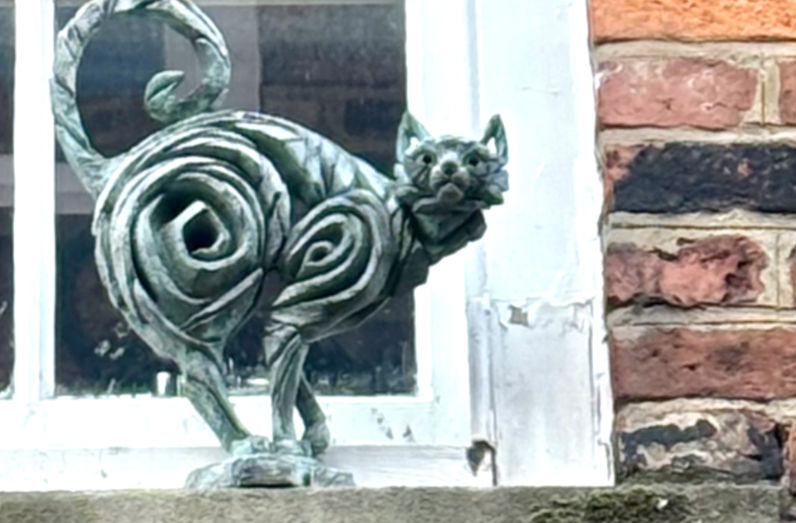
Cities might have features above designed for visitors to find and enjoy. The York Cat Hunt is such an attraction, as a series of iron cats strewn about the city on the sides of buildings, on rooftops, in windowsills, and more. Being low-vision, I have to use my camera when I spot something dark overhead, to zoom in and determine if it's one of the cats or just a utility box.
One thing is very important to remember when looking up: stop your feet. Continuing on your path blindly (unfortunate word choice, I know) will undoubtedlky lead to disaster. Howver, so will stopping your feet while the feet behind you don't stop. My best advice is to move aside, then look up!
Be saafe, though. Some cities are plagued by pickpockets and phone/camera thiefs. Keep a good grip on your things while snapping photos.
Let me know if you've encountered any other such situations on your travels. What works for you?
Until next time, safe travels...and mind the gap!


Comments